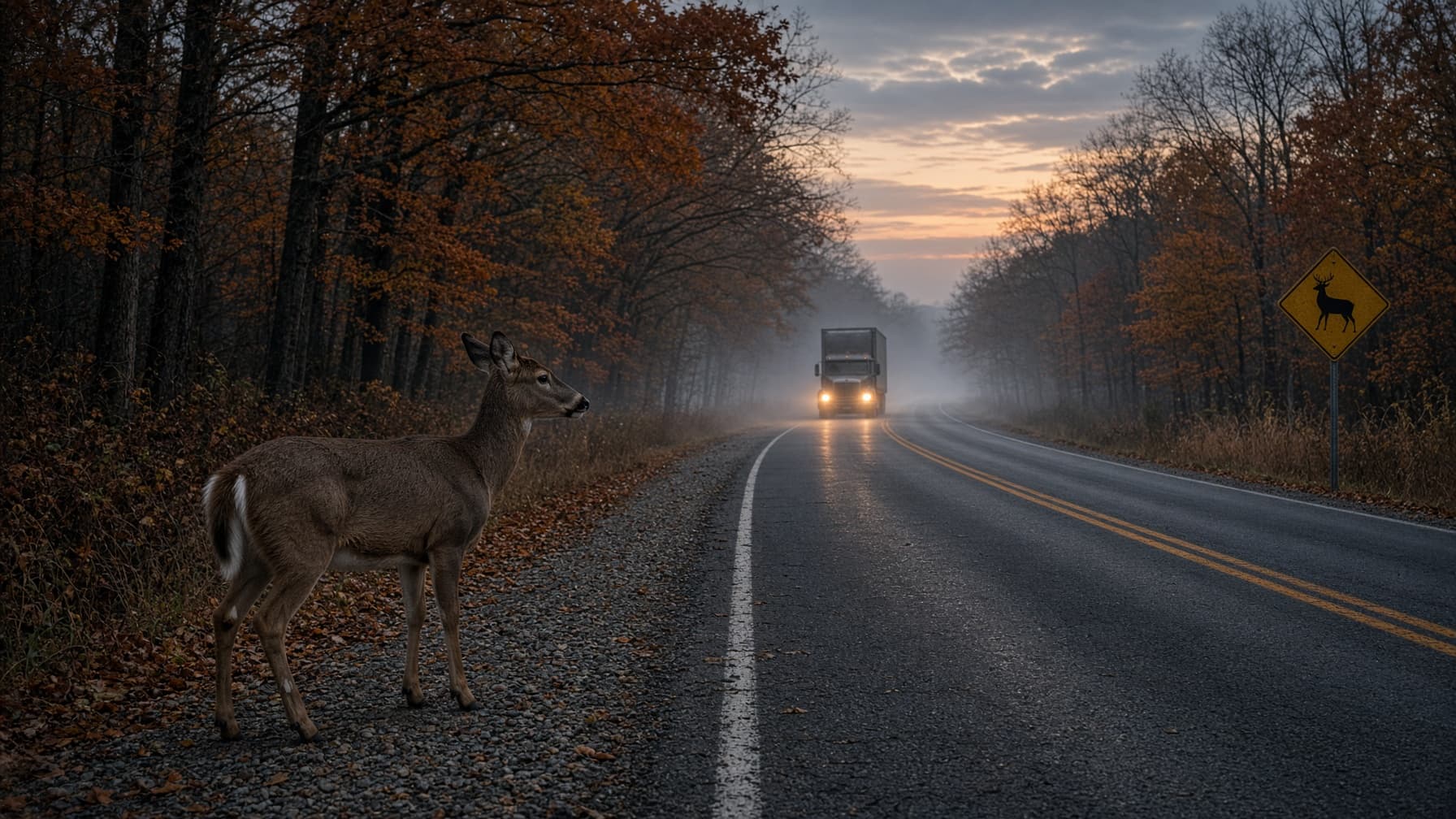
State Farm's latest data counts more than 1.6 million animal-vehicle collision claims in the U.S. between July 2025 and June 2026, costing $1.9 billion. The worst months, in order, are November, October and December. That's mating season and hunting season, and deer move most around dawn and dusk.
For a passenger car, a deer is the hazard. For a tractor-trailer, the hazard is usually what the driver does to avoid it.
This is general safety guidance, not legal advice.
Where the risk is highest
The national odds of an animal collision are about 1 in 145. The states with the highest odds:
- West Virginia: 1 in 46
- Montana: 1 in 54
- Wisconsin: 1 in 62
- Pennsylvania: 1 in 64
- Michigan: 1 in 68
Pennsylvania has the highest raw number of claims. If your lanes run through the upper Midwest, Appalachia or the northern Plains, this is your season.
What to train your drivers to do
Don't swerve. This is the whole lesson. A loaded truck that jerks the wheel at highway speed risks a jackknife, a rollover, a trip into the oncoming lane, or leaving the road. Hitting the deer is almost always the better outcome.
Brake firmly in a straight line. Slow as much as possible and hold the lane. Sound the horn if there's time.
Expect more than one. Deer travel in groups. When one crosses, the next is often a few seconds behind.
Scan the shoulders at dawn and dusk. Eyeshine shows up well before the animal does. Use high beams where there's no oncoming traffic.
Take deer-crossing signs seriously. They go up where strikes keep happening.
Don't count on gadgets. Evidence that deer whistles work is weak. Speed and attention do far more.
After a strike
- Get the truck safely off the road with hazards on, and put out warning devices if the truck is stopped on the shoulder.
- Don't approach an injured animal. A wounded deer can do real harm.
- Inspect before moving on. Look at the radiator, air lines, lights, fuel tanks and the hood latch. A strike that looks cosmetic can take out a headlight or crack something that fails fifty miles later.
- Photograph everything, including the animal, the damage and the road, and save the dash cam clip.
- Report it to dispatch and, where required, to local law enforcement.
Is it a DOT-recordable crash?
That depends on the outcome, not the cause. Under FMCSA's definition, a crash is recordable if it involves a fatality, an injury treated away from the scene, or a vehicle towed from the scene because of disabling damage.
A deer strike that disables the truck and needs a tow is recordable. It goes on your accident register and into your safety data, like any other crash.
Post-accident drug and alcohol testing follows its own rules. It's required after a fatality, or after an injury or tow-away crash where the driver receives a citation. An animal strike with a tow-away and no citation doesn't trigger a test on its own. Check our Clearinghouse guide for how testing records are handled.
Keep it off your CSA score
Animal strikes are one of the crash types eligible for FMCSA's Crash Preventability Determination Program. If a recordable deer strike lands on your profile, you can request a review through DataQs and ask that it be marked not preventable. That's another reason to keep the photos and the video.
We explain the program and the rest of the scoring in how to lower your CSA scores.
Quick answers
When are deer collisions most likely? November, then October, then December, especially around dawn and dusk.
Should a truck driver swerve to avoid a deer? No. Brake firmly in a straight line and stay in the lane. The swerve is more dangerous than the strike.
Is hitting a deer a DOT-recordable crash? Only if it results in a fatality, an injury treated away from the scene, or a vehicle towed because of disabling damage.
Can an animal strike be removed from my CSA score? You can request a not-preventable determination through the Crash Preventability Determination Program.
Sources
- Carrier Management: Animal collisions continue to decline, with 1.6M recorded in latest year
- State Farm: How likely are you to have an animal collision?
- FMCSA: Crash Preventability Determination Program — Eligibility Guide
- eCFR: 49 CFR 390.5, Definitions (accident)
- eCFR: 49 CFR 382.303, Post-accident testing