
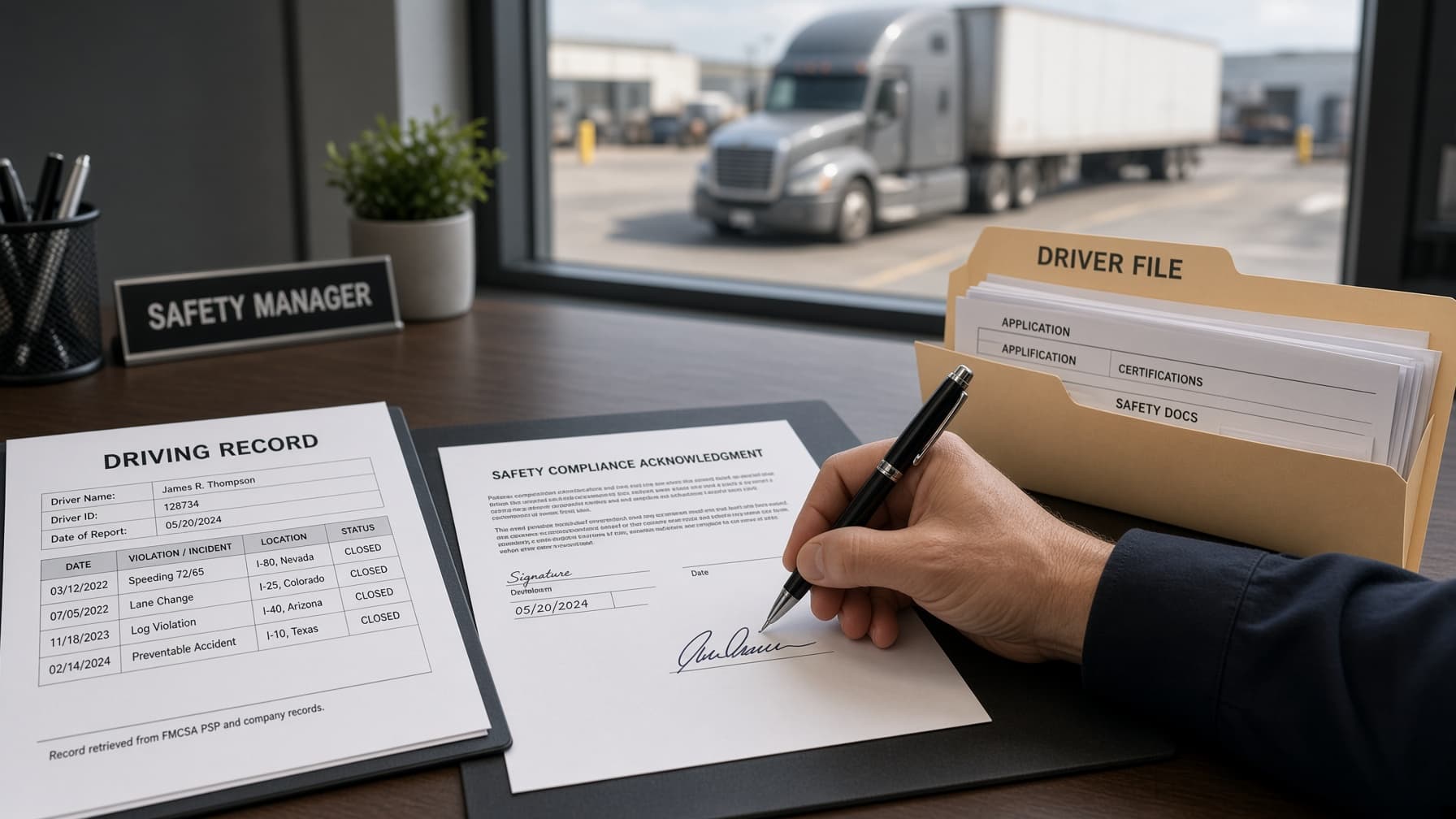
Every motor carrier has to review each driver's driving record at least once every 12 months. The rule is 49 CFR 391.25. It takes a few minutes per driver, and a missing or out-of-date one is among the most common findings in a DOT audit.
This is a compliance summary, not legal advice.
What the rule requires
There are three parts.
1. Get the record. At least once every 12 months, get a motor vehicle record for each driver covering at least the preceding 12 months, from every state or licensing authority where the driver held a commercial licence or permit during that time.
That last part is easy to miss. A driver who moved from Indiana to Ohio in March needs records from both states.
2. Review it. Someone at the carrier has to look at the record and decide whether the driver still meets the minimum requirements for safe driving, or is disqualified. The rule tells the reviewer to give great weight to violations such as:
- speeding,
- reckless driving,
- operating while under the influence of alcohol or drugs,
because they show a disregard for public safety.
3. Document it. Put a note in the driver qualification file with the name of the person who did the review and the date. Keep the MVR in the file as well.
What changed in 2022
Drivers used to have to give their employer a signed annual list of their violations under 49 CFR 391.27. FMCSA removed that requirement effective May 9, 2022, because the MVR already shows the same information.
If your annual review packet still asks drivers for a certificate of violations, you can drop it. You don't have to, but it isn't required, and an auditor won't look for it.
How long to keep it
Keep the annual review note and the MVR for three years from the date of the review.
The gaps auditors find
- A single state. The driver held a licence elsewhere during the year and nobody pulled that record.
- Thirteen months, not twelve. Doing reviews "every year around the holidays" drifts. The requirement is at least once every 12 months, per driver.
- An MVR with no review. Pulling the record isn't the review. Without the reviewer's name and date, you can't show it happened.
- A review that ignored something. Signing off on a record with a recent serious violation, and doing nothing about it, is worse in litigation than no review at all.
- New hires counted from the wrong date. The annual clock for a new driver starts from their pre-employment MVR, not from your next company-wide review.
Pair it with the Clearinghouse query
The annual MVR isn't the only annual check. Carriers also have to run a Drug and Alcohol Clearinghouse query on every driver at least once a year. Running both together, and filing both, keeps two recurring obligations on one calendar. See our Clearinghouse compliance guide.
It's also worth checking the driver's medical certification status on the MVR while you have it open. With certification now filed electronically, a missed posting can downgrade a CDL without anyone being told.
Consider continuous monitoring
The annual review is a minimum. Many fleets now subscribe to continuous MVR monitoring, which alerts you when a driver gets a new conviction, suspension or downgrade instead of leaving you to find out months later.
It doesn't replace the annual review, and you still have to document it. It closes the eleven-month blind spot between reviews.
Why it matters beyond the audit
After a crash, the first line of attack on a carrier is negligent retention: you knew, or should have known, the driver was unsafe and kept them anyway. The annual review is the dated, signed evidence of what you knew and what you did about it.
A review that shows you saw a speeding conviction and coached the driver defends you. A review that shows you saw it and did nothing works against you. No review at all leaves your attorney with nothing. See the safety director deposition for how that plays out.
Quick answers
How often do I have to review a driver's MVR? At least once every 12 months, under 49 CFR 391.25.
Which states do I pull from? Every state where the driver held a CMV licence or permit during the preceding 12 months.
Do drivers still have to give me a list of their violations? No. FMCSA removed that requirement (391.27) effective May 9, 2022.
How long do I keep annual review records? Three years from the date of the review.