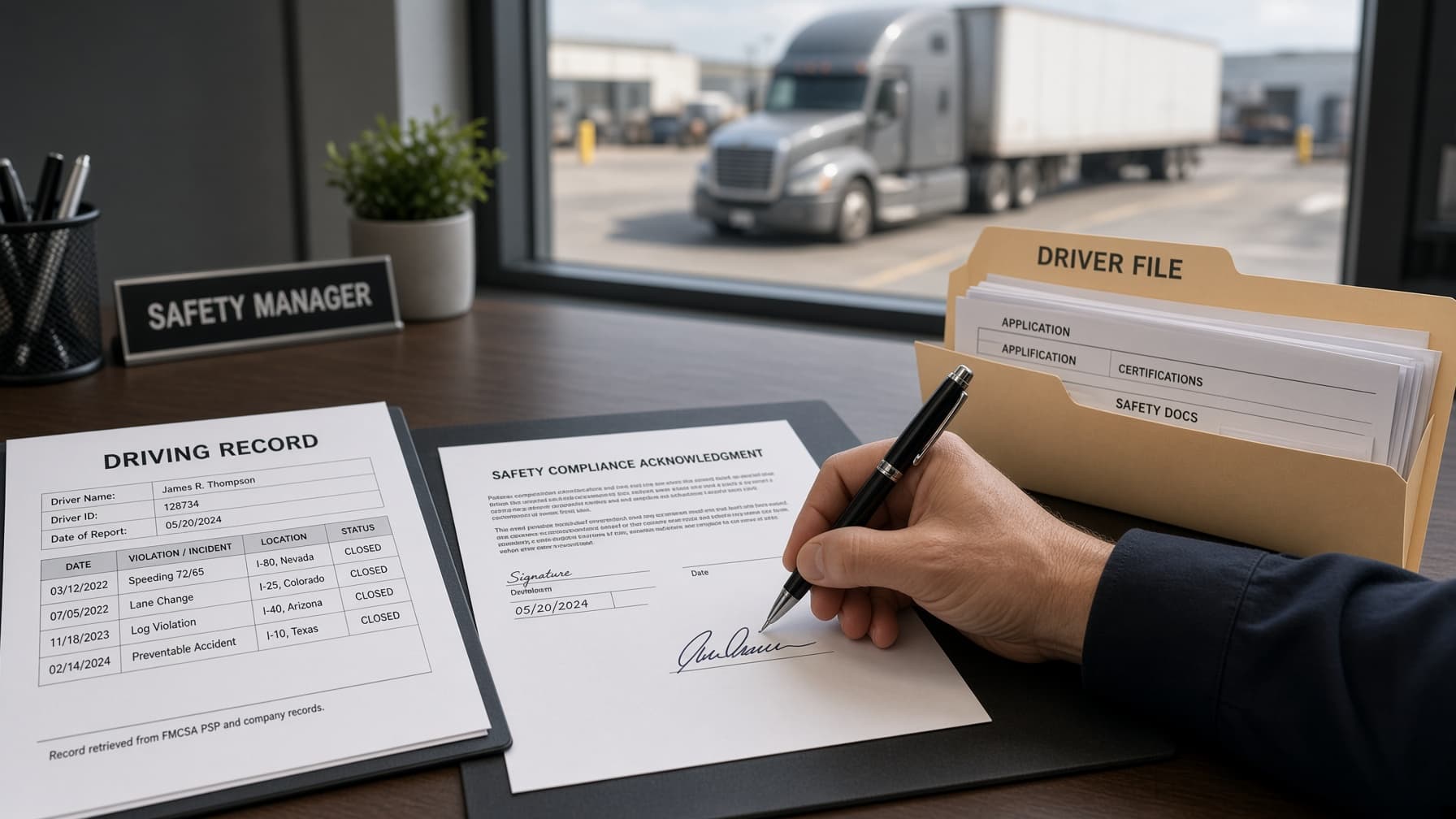

A DOT audit notice — whether it's a new-entrant safety audit, a focused review, or a full compliance review — usually gives you a short window, often just a couple of weeks, to produce your records. Auditors aren't trying to trick you; they're checking that the safety systems you're required to have actually exist and are documented. The carriers that fail rarely fail because they're unsafe. They fail because they can't produce the paperwork to prove it.
What auditors are really checking
Most reviews map to the FMCSA's safety categories: driver qualification, hours of service, drug and alcohol testing, vehicle maintenance, and accident history. For each one, the question is the same — can you show a complete, current, dated record for every driver and every truck?
The document checklist
Pull these together before your audit date:
- Driver Qualification files for every driver — application, MVRs, annual review of driving record, road test/CDL, and current DOT medical certificate.
- Drug & alcohol testing program records — pre-employment tests, random selection pool, and any post-accident or reasonable-suspicion tests.
- Hours-of-Service / ELD records and supporting documents for the review period.
- Vehicle maintenance files — DVIRs, repair and maintenance history, and annual inspection records for each truck and trailer.
- An accident register, plus proof of insurance and your operating authority.
- Your written safety policies and proof drivers were trained on them.
Where carriers lose points
The most common findings are boring and avoidable: an expired medical card nobody caught, a missing annual MVR, a driver with no proof of training, a truck with no record of its last inspection. Individually small; together they're the difference between a clean audit and a conditional rating that raises your insurance and scares off shippers.
How to stay audit-ready
The reason those gaps happen is that expiration dates are invisible when records live in filing cabinets and scattered spreadsheets. Track every CDL, medical card, annual review, registration, and inspection in one place, flag what's expiring well ahead of time, and keep each driver's and truck's full history together. When the audit notice arrives, you're not scrambling — you're printing a file that's already complete.
The best time to prepare for an audit is before you're selected. If you just got the notice, the second-best time is right now.
DOT audit questions carriers ask
What documents do you need for a DOT audit? Driver qualification files, drug and alcohol testing program records, hours-of-service and ELD data, vehicle maintenance and annual inspection files, your accident register, proof of insurance and operating authority, and your written safety policies.
How long do you have after a new entrant safety audit notice? It varies, but the window is usually short — often a couple of weeks — so start gathering records the day the notice arrives rather than waiting for the audit date.
What happens if you fail a DOT compliance review? A failed audit can lead to a conditional or unsatisfactory safety rating, higher insurance premiums, lost shipper contracts, and in serious cases an order to cease operations — which is why clean, complete documentation matters so much.